
Managed Servers and Websites for Oakville Businesses
Oakville's offices and retailers depend on a website, an online store or a few servers that need steady attention. I keep watch with automation through the night and a senior engineer on the decisions, then explain it all in a monthly report. I work remote first, with a visit to Oakville by arrangement.
Your servers and website, watched around the clock, patched on a schedule and explained once a month in a report written for the owner.
Automation watches uptime, certificates, DNS, key pages and your lead or checkout path every minute. I review what it finds, apply patches in an agreed window and send you a short monthly report in everyday terms. Beyond the watching, I am the engineer you call for whatever the systems need next, from a migration or a new integration to a hard question about a vendor.
Start with an Onboarding Audit
Onboarding Audit
A look at every server and site you run.
Book an Onboarding Audit- Action list on a single page
- Prioritized findings with evidence
- Written quote for the fixes
- What to watch and what to fix first
Free external security check
Seven checks on one domain: TLS and certificate expiry, DNS hygiene, email authentication (SPF, DKIM, DMARC), open ports, security headers, forgotten subdomains from certificate logs and leaked software versions, plus a few additional checks. Requested through the contact form, for a domain you own or run, proven with a DNS record before I scan. Delivered as a short note, sent back encrypted.
Request the free checkJobs are quoted in writing after a free scope, so you know the number before any work starts.
How the automation and I split the work
Automation covers the nights. I make the decisions.
Monitoring runs on systems I control, checking every minute. When something trips, a fix from a reviewed list approved in advance may run on its own, like restarting a stuck service, renewing a certificate or clearing space before a disk fills. Anything outside that list waits for a human.
Automated actions are logged and show up in your monthly report. Investigations and report drafting may use a cloud AI provider, disclosed in the privacy policy. An option that runs only locally is available per client. Nothing runs against your systems that I have not reviewed.
Automated actions are logged and show up in your monthly report. Investigations and report drafting may use a cloud AI provider, disclosed in the privacy policy. An option that runs only locally is available per client. Nothing runs against your systems that I have not reviewed.
Faster pages, same server

Performance and efficiency
Most slow sites are not short of hardware. They are paying for a broken cache, a plugin that phones home on every request, a monitoring scrape that returns errors or a redirect that boots the whole application first. I measure first, with request timing, packet captures and profiling on a staging copy, then fix the cause and measure again.
On a WooCommerce store this found a broken object cache and one faulty integration behind most of the load. Same server, no upgrade, before and after:
On a WooCommerce store this found a broken object cache and one faulty integration behind most of the load. Same server, no upgrade, before and after:
| Home | 49% faster | |
|---|---|---|
| Shop | 43% faster | |
| Cart | 39% faster | |
| Product page | 44% faster | |
| Events | 58% faster |
Why this matters. Every extra half second on a shop page costs real orders, because shoppers on phones give up and search engines rank slower sites lower. Faster pages also mean the same server handles more visitors on a busy day without falling over, so a sale or a social media mention does not take the store down. And it was done without a hosting upgrade, so there is no new monthly bill.
For sites I build, performance is designed in: static where possible, images sized and lazy loaded, no outside scripts and a Lighthouse score in the high 90s on mobile before launch.
For sites I build, performance is designed in: static where possible, images sized and lazy loaded, no outside scripts and a Lighthouse score in the high 90s on mobile before launch.
Updates rehearsed before they touch the store

A safe update kit, proven on a live shop
Plugin, theme and platform updates are where most small business sites break, usually on a Saturday.
I built an update kit that takes the gamble out. Updates are rehearsed first and checked automatically, visually and functionally, across the pages and shopper journeys that matter, before the live site is touched. If a check fails, the update is rolled back on its own and you hear about it in the monthly report instead of from a customer. The kit also knows the difference between rolling back a plugin and rolling back your data, so a real order that arrived during the window is never lost to a restore.
On a client's shop it has already caught an update that broke the store and reverted it within minutes, before any customer noticed.
Custom plugins, written and maintained. When WordPress cannot do what your business needs out of the box, I write the plugin instead of bolting on three that almost fit. For a farm store that meant a custom WooCommerce shipping plugin that quotes live courier rates at checkout, logs every lookup, falls back safely when the courier is slow and is watched so a stale rate gets noticed before a customer does. Plugins I write are kept current with each WordPress and WooCommerce release as part of managed care, so your custom features keep working through every update.
I built an update kit that takes the gamble out. Updates are rehearsed first and checked automatically, visually and functionally, across the pages and shopper journeys that matter, before the live site is touched. If a check fails, the update is rolled back on its own and you hear about it in the monthly report instead of from a customer. The kit also knows the difference between rolling back a plugin and rolling back your data, so a real order that arrived during the window is never lost to a restore.
On a client's shop it has already caught an update that broke the store and reverted it within minutes, before any customer noticed.
Custom plugins, written and maintained. When WordPress cannot do what your business needs out of the box, I write the plugin instead of bolting on three that almost fit. For a farm store that meant a custom WooCommerce shipping plugin that quotes live courier rates at checkout, logs every lookup, falls back safely when the courier is slow and is watched so a stale rate gets noticed before a customer does. Plugins I write are kept current with each WordPress and WooCommerce release as part of managed care, so your custom features keep working through every update.
Monitoring built around what matters to you

Custom monitoring and dashboards
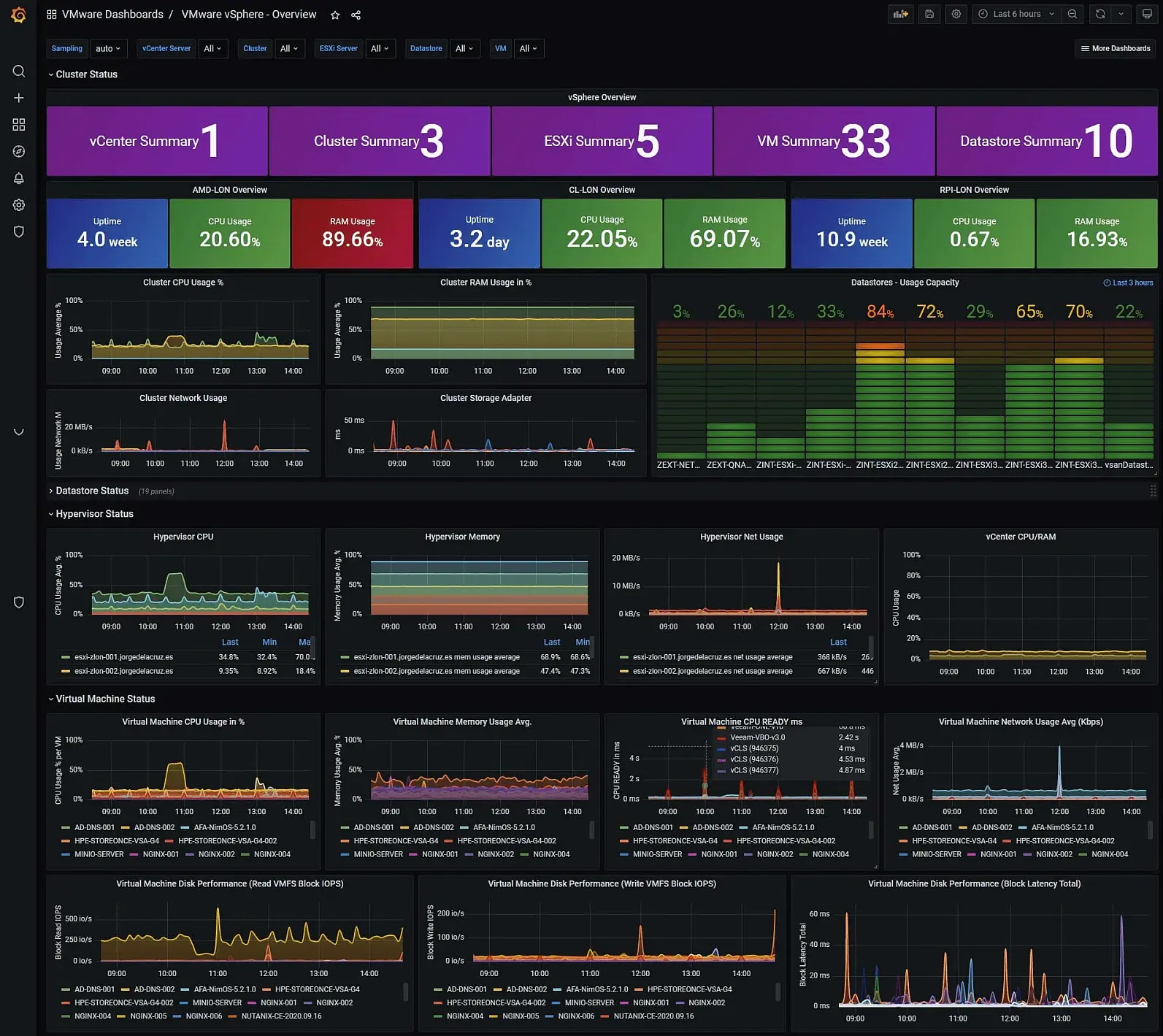
Off the shelf monitoring tells you a server is up. It does not tell you that the checkout path works, that today's leads reached the CRM, that the backup restored cleanly or that a shipping label printed. I build checks for the things your business runs on, feed them into dashboards you can read at a glance and route alerts to a human only when a human needs to act.
That includes dashboards for a wall screen in the office or workshop, a daily health email anyone in the office can follow and synthetic tests that walk through your real workflows on a schedule. I run the same stack for my own business, including video security monitoring with AI help, hosted on my own servers for my own premises, so the tooling is proven before it reaches a client.
That includes dashboards for a wall screen in the office or workshop, a daily health email anyone in the office can follow and synthetic tests that walk through your real workflows on a schedule. I run the same stack for my own business, including video security monitoring with AI help, hosted on my own servers for my own premises, so the tooling is proven before it reaches a client.
Your own servers, watched. Canadian hosted, Canadian controlled

Sovereignty is a feature
Running your own servers instead of renting everything is cheaper and keeps your data yours, but only if someone is watching them. I have inherited fleets where a storage volume had been stalled for months, a DNS zone had been frozen for weeks and servers had not been backed up or rebooted in over a year, and no one knew, because nothing was looking. The first thing I do is an inventory and monitoring that shows what is missing, then nightly backups with restores that get tested on a schedule.
There is a bigger reason to own the servers too. Data held by US cloud providers is reachable by US authorities under the CLOUD Act, wherever the data centre sits, and a service you rent can change terms, prices or ownership overnight. For a Canadian business that would rather not have its customer records subject to a foreign government or a foreign boardroom, I set up systems on Canadian owned infrastructure, in Canada, under your control, with the same monitoring, patching and backups as everything else I run.
My own product, ReceiveVault, is built and hosted that way, and so is this site. If a pro Canada stance matters to your customers, it is a sovereignty story you can tell them truthfully.
There is a bigger reason to own the servers too. Data held by US cloud providers is reachable by US authorities under the CLOUD Act, wherever the data centre sits, and a service you rent can change terms, prices or ownership overnight. For a Canadian business that would rather not have its customer records subject to a foreign government or a foreign boardroom, I set up systems on Canadian owned infrastructure, in Canada, under your control, with the same monitoring, patching and backups as everything else I run.
My own product, ReceiveVault, is built and hosted that way, and so is this site. If a pro Canada stance matters to your customers, it is a sovereignty story you can tell them truthfully.
Keep the store selling

Health, efficiency and ideas for online shops
An online store has one job and dozens of ways to stop doing it without anyone noticing. Shipping quotes time out, a plugin breaks add to cart on one phone model, a payment gateway drops a checkout for a day, and the only signal is that orders are a little down. I watch the sales path itself, from the shop page through the cart, the shipping quote and the checkout to the order confirmation, with alerts that fire when any step stops working, long before the server itself goes down.
On one store that meant tracing an add to cart crash that had been firing several times a day for weeks to a single line of code, putting proper metrics and alerts on shipping quotes that had none and picking the maintenance window from a year of order data so updates land when the fewest customers are shopping.
I also read what the data says about the business. Where the mobile share of traffic is climbing, where shoppers drop off, which pages are slow where it hurts and what to fix first for the biggest lift in sales. You get the fixes, plus practical ideas to improve store performance, as part of the monthly report.
On one store that meant tracing an add to cart crash that had been firing several times a day for weeks to a single line of code, putting proper metrics and alerts on shipping quotes that had none and picking the maintenance window from a year of order data so updates land when the fewest customers are shopping.
I also read what the data says about the business. Where the mobile share of traffic is climbing, where shoppers drop off, which pages are slow where it hurts and what to fix first for the biggest lift in sales. You get the fixes, plus practical ideas to improve store performance, as part of the monthly report.
Own your tools, not another subscription

Replacements you host yourself, instead of monthly fees
Many of the tools a small business rents monthly, such as monitoring, uptime checks, file sharing, password management, booking, forms, analytics, backups, camera systems and automation glue charged per task, have excellent open source equivalents. I set them up on a server you control, keep them patched and backed up, and your data stays yours.
What you get is one engineer billed for the work instead of a stack of subscriptions charged per seat, no vendor login that can lock you out or change its terms and no third party holding your customer data. Where a hosted product is the right call, I will say so.
An example: for a licensed electrical contractor I run TimeTrex, an open source time and attendance system, as a managed service. I configured it for their pay rules and crews, trained the office on it, onboarded every employee and keep it patched, backed up nightly and watched. They get a payroll ready time system with no licence per employee, billed for the work.
What you get is one engineer billed for the work instead of a stack of subscriptions charged per seat, no vendor login that can lock you out or change its terms and no third party holding your customer data. Where a hosted product is the right call, I will say so.
An example: for a licensed electrical contractor I run TimeTrex, an open source time and attendance system, as a managed service. I configured it for their pay rules and crews, trained the office on it, onboarded every employee and keep it patched, backed up nightly and watched. They get a payroll ready time system with no licence per employee, billed for the work.
Billed for the work, not a package
There is no tier to pick and no retainer to sign. You pay for the hosting you use and the hours of a senior engineer, itemised on every invoice. Automation does the watching around the clock. When something needs judgement or hands, that is my time, and you see exactly where it went.
What the watching covers on every system I look after:
What the watching covers on every system I look after:
- Uptime, TLS, DNS, key pages and the lead or checkout path checked every minute
- Server health, security events and vulnerability scans, triaged by me
- A monthly patch window with notice and your approval, through a staging copy where one exists
- Safe fixes approved in advance, such as restarting a stuck service or renewing a certificate
- Backups monitored, with offsite copies and restore tests where the data warrants it
- A monthly report for the owner in everyday terms
Who this is for
Any business that runs on systems it does not have the staff to look after. A website, an online store, the app your crew quotes and schedules in, a few servers, cloud accounts or the computers and network in the office.
The clients I do this for today: an online store on WooCommerce, a contractor with a quoting app, a marketing firm with a lead pipeline, a professional practice with client data to protect, an electrical contractor whose whole IT desk I run (hardened Linux desktops, email, website, time tracking and security advice) and web agencies that want a senior engineer behind their client sites.
Take on as much or as little as you need. One server watched and patched, or full responsibility for your production platform, including architecture, deployments, security, backups, monitoring and vendor coordination, with a named engineer who knows your setup. See how that looks in practice.
The clients I do this for today: an online store on WooCommerce, a contractor with a quoting app, a marketing firm with a lead pipeline, a professional practice with client data to protect, an electrical contractor whose whole IT desk I run (hardened Linux desktops, email, website, time tracking and security advice) and web agencies that want a senior engineer behind their client sites.
Take on as much or as little as you need. One server watched and patched, or full responsibility for your production platform, including architecture, deployments, security, backups, monitoring and vendor coordination, with a named engineer who knows your setup. See how that looks in practice.
Managed service questions
- A short written list, agreed with you at onboarding, of actions automation may take without asking: restarting a known service, renewing a certificate, clearing a full log partition. The rest waits for me. Every action is logged.
What this looks like on a real site
Viscous Bits has been an irreplaceable partner to our business for years. They built us a Virtual Private Server and still maintain it, moved all of our lead generation sites onto it and modernized every one of them. They have built many web applications for us over the years and replaced our Zapier subscriptions with custom coded APIs, which took a recurring cost off our books. When we need a new site they help us stand one up in days with AI. If a lead ever goes missing they find it and get it back to us, and when one of our clients escalates a problem they respond right away. We are especially impressed with the personal service and quick turnaround time.
- Secret Lands FarmA farm store that stays safe and keeps sellingA family farm's online store moved to a faster server, kept up to date safely, watched day and night and explained to the owners once a month.Read the case study
- PestZerro Inc.IT for a company that did not think it needed anyA new pest control business with one owner, one truck and a phone full of customer details. A consultation, a short list of fixes and an IT department on call ever since.Read the case study
- Ostrich Land OntarioEyes on the farm, day and nightA working ostrich farm that is also a visitor attraction. Desktop support first, then a security camera system covering the grounds and the store.Read the case study
Get a free external security check
Seven checks on one domain, results sent back encrypted. Ownership proven with a DNS record first. Or go straight to an Onboarding Audit.